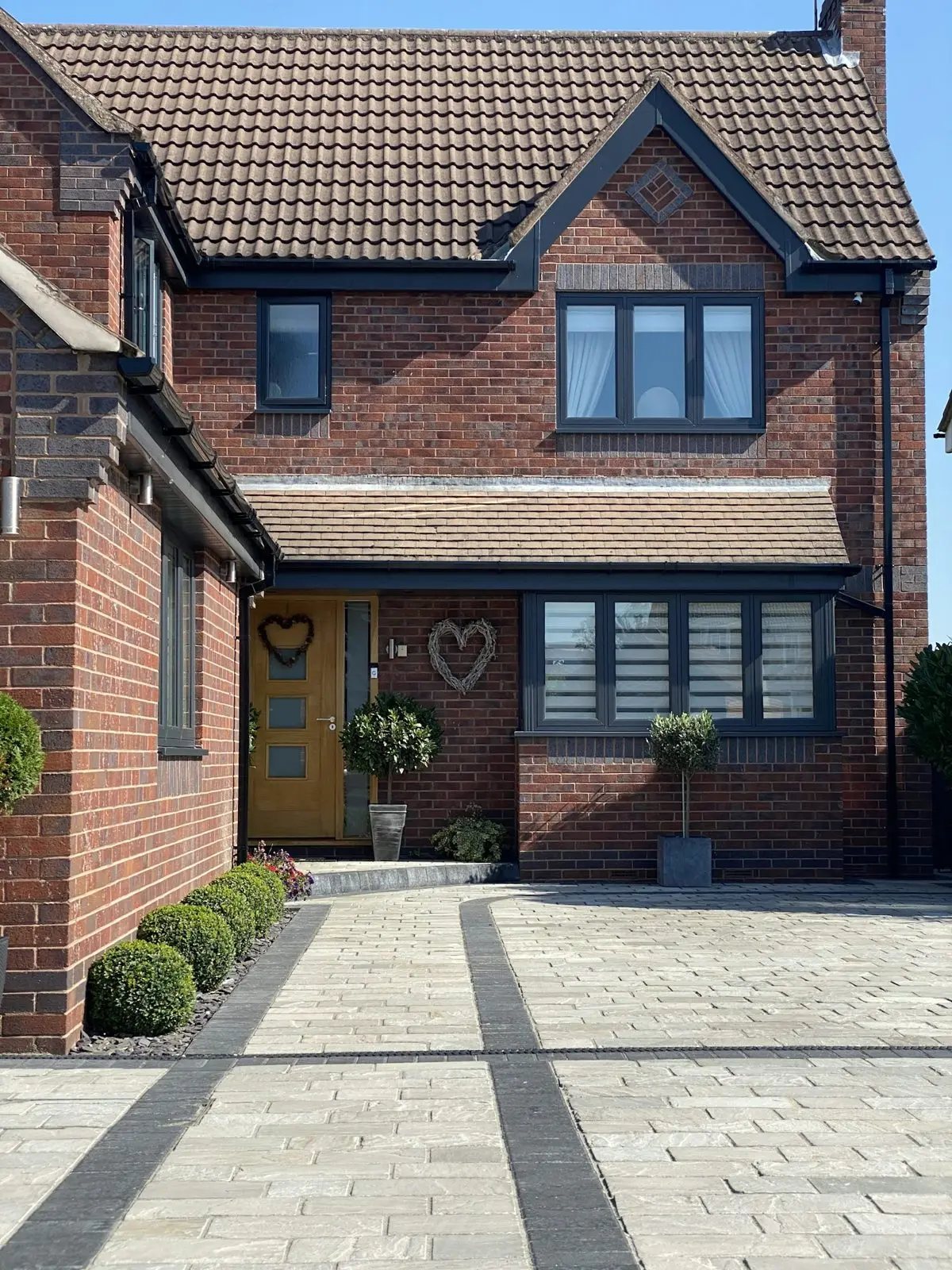
Last updated October 2026
In England, a permeable resin bound driveway on a house usually needs no planning permission, whatever its size. Permission is normally needed for a non-permeable front drive over 5 m2, and for flats, many listed buildings and homes where an Article 4 direction removes the right. Wales, Scotland and Northern Ireland have similar rules with their own twists, and the dropped kerb always needs the council’s consent. This is our reading of the rules, not legal advice. As a guide to the drive itself, two cars on about 50 m2 of resin bound typically come to £4,000 to £7,500 at UK prices.
A permeable resin bound drive is the simplest way to stay out of planning at the front of a house in all four nations.
| Nation | Rule for a front hard surface | Extra point |
|---|---|---|
| England | Over 5 m2 between the house and a road: must be porous or drain to a permeable area within the property, or it needs planning permission | Flats and maisonettes have no permitted rights; some converted homes excluded |
| Wales | Any new or replacement front surface must be permeable or drain to a permeable area; replacing up to 5 m2 is allowed | Drives of 100 m2 or more may need sustainable drainage (SAB) approval, fees £420 to £7,500 |
| Scotland | Any surface between the house and a road must be porous or drain to a porous area in the garden | Conservation areas and homes near listed buildings fall outside permitted development |
| Northern Ireland | At the front, over 5 m2, the surface must be porous or permeable or drain to a porous area | Any new or altered access needs DfI Roads consent, even without planning |
England: the 5 m2 rule and permeable surfaces
A front drive of any size needs no planning permission if it is permeable or drains to a permeable area within the property. The rule, in Class F of the General Permitted Development Order 2015, came in on 1 October 2008. GOV.UK’s guidance says a new or replacement driveway “of any size” using permeable surfacing needs no permission, while laying a traditional impermeable surface over more than 5 m2 does.
Resin bound meets that test when it is laid on a porous base. The same resin laid on solid tarmac with no drainage does not drain any better than the tarmac, so the installer has to take the water somewhere permeable.
Wales: permeable surfaces and SAB approval over 100 m2
Every new or replacement front surface in Wales must be permeable or drain to a permeable area, says the Welsh Government, though repairing or replacing up to 5 m2 of existing hard surface is allowed. Wales also requires sustainable drainage approval from the council’s SuDS Approval Body for construction of 100 m2 or more; work that needs no planning permission is exempt unless it covers 100 m2 or more. SAB fees, in Newport’s published schedule, run from £420 up to £7,500. Check with your council’s SAB before a large drive is quoted.
Scotland: surfaces between the house and a road
In Scotland, any hard surface between the house and a road must be porous or drain to a porous area in the garden, according to mygov.scot. That is stricter than England on location, because there is no 5 m2 allowance. A home in a conservation area, or near a listed building, falls outside permitted development altogether, so planning permission is needed.
Northern Ireland: DfI Roads consent for access
Planning permission is not normally needed for a parking surface within the garden, but at the front a surface over 5 m2 must be porous or permeable, or drain to a porous area, according to Mid and East Antrim Borough Council’s guidance. Separately, any new or altered access onto a road must go to DfI Roads, even where no planning permission is needed, and a new access onto a trunk or classified road needs planning permission.
Flats, listed buildings, conservation areas and Article 4
Each of these can take away the permitted right. Flats and maisonettes have no permitted rights for hard surfaces, listed buildings need listed building consent for significant work, and GOV.UK says different rules apply in conservation areas, World Heritage Sites and National Parks. An Article 4 direction can also remove the right street by street: in Croydon, The Waldrons direction has withdrawn it at 5 to 23 The Waldrons since 21 January 2016, to protect front gardens, so even a permeable resin drive there needs planning permission. Ask your council whether one applies to your address.
Is resin bonded treated differently?
Yes, because bonded resin is not permeable. A bonded front drive over 5 m2 in England needs planning permission unless its water runs to a lawn, border or soakaway within the property. Our guide to resin bound vs resin bonded compares the two.
How it works
- 01Send photos of the driveRough size, what is there now and your postcode.
- 02We visitThe ground under the drive, the levels and where the water goes are checked.
- 03Written priceThe base, edging and drainage as their own lines.
Do I need permission for the dropped kerb?
Yes, always from the highway authority, and sometimes planning permission too. GOV.UK’s guidance says you will need the council’s permission to drop the kerb, and most councils ask for planning permission first on classified roads. Fees run from £50 to over £500; see dropped kerb cost for each council’s process.
What are SuDS, and do they apply to a home driveway?
SuDS are sustainable drainage systems: ways of slowing and soaking up rain on site rather than sending it to drains. In Wales they are mandatory for construction of 100 m2 or more. In England, the law to make SuDS approval mandatory (Schedule 3 of the Flood and Water Management Act 2010) had not been brought in as of July 2025, according to CIWEM, and we found no source showing it has since. So for an English house drive the test is still the permeable surface rule above.
How we handle it on your job
Alex Winser checks which nation’s rule applies and whether your address is in a conservation area or under an Article 4 direction before the quote, and the installers lay the drive to drain as the rules require. Where a planning application or kerb consent is needed, the quote says so. The Resin Drive Company is a WeDo Property Services service.
Illustrative example
Based on the nation table alone, with no real job behind it.
A semi-detached house in England wants a 45 m2 front drive. In permeable resin bound on a porous base it falls within permitted development; in resin bonded on solid tarmac it would need planning permission unless the water is taken to a soakaway. If the same house were in Wales, a 45 m2 drive would still be under the 100 m2 sustainable drainage threshold.
Often needed alongside
- Resin driveways across the UK
- Resin driveway cost, with drainage priced as its own line
- Resin driveways near me, with your council’s own rules
FAQs
Are resin driveways permeable?
Resin bound is, when laid on a porous base; resin bonded is not.
Does the 5 m2 rule apply to my back garden?
No. In England it applies to surfaces between the front of the house and a highway.
What if I have already laid an impermeable drive?
Ask your council; a retrospective planning application or adding drainage to a permeable area may be options.
Do manufacturers say their resin is permeable?
Some do: SureSet describes its system as “fully SuDS compliant”, though it publishes no flow rate.
Does a new build house have these rights?
Not always. Class F excludes some homes created by changes of use under prior approval, and homes built under Part 20, so check with your council.
Sources
- legislation.gov.uk, GPDO 2015 Schedule 2 Part 1 Class F, 2015 as amended
- GOV.UK, Guidance on the permeable surfacing of front gardens, updated Feb 2026
- Planning Portal, Patios and driveways planning permission, undated
- Welsh Government, Planning permission: patio and driveway, undated
- Newport City Council, Sustainable drainage systems, read Oct 2026
- mygov.scot, Lay a hard surface outside your house, Nov 2025
- Mid and East Antrim Borough Council, Your home and planning permission, read Oct 2026
- Croydon Council, The Waldrons Article 4 direction, direction from Jan 2016
- SureSet, Main resin brochure 2025, 2025
- CIWEM, SuDS: common sense stuck in stagnation, July 2025